
The ability for leaders to quickly adapt and translate marketplace shifts into business strategies that employees can support is paramount. And how leaders guide their teams through these tough challenges can mean the difference between an organization thriving or closing its doors for good.
Organizations that proactively cultivate future leaders are in a much better position to ensure business continuity and growth no matter the pace or frequency of change. The big opportunity is how to do that effectively.
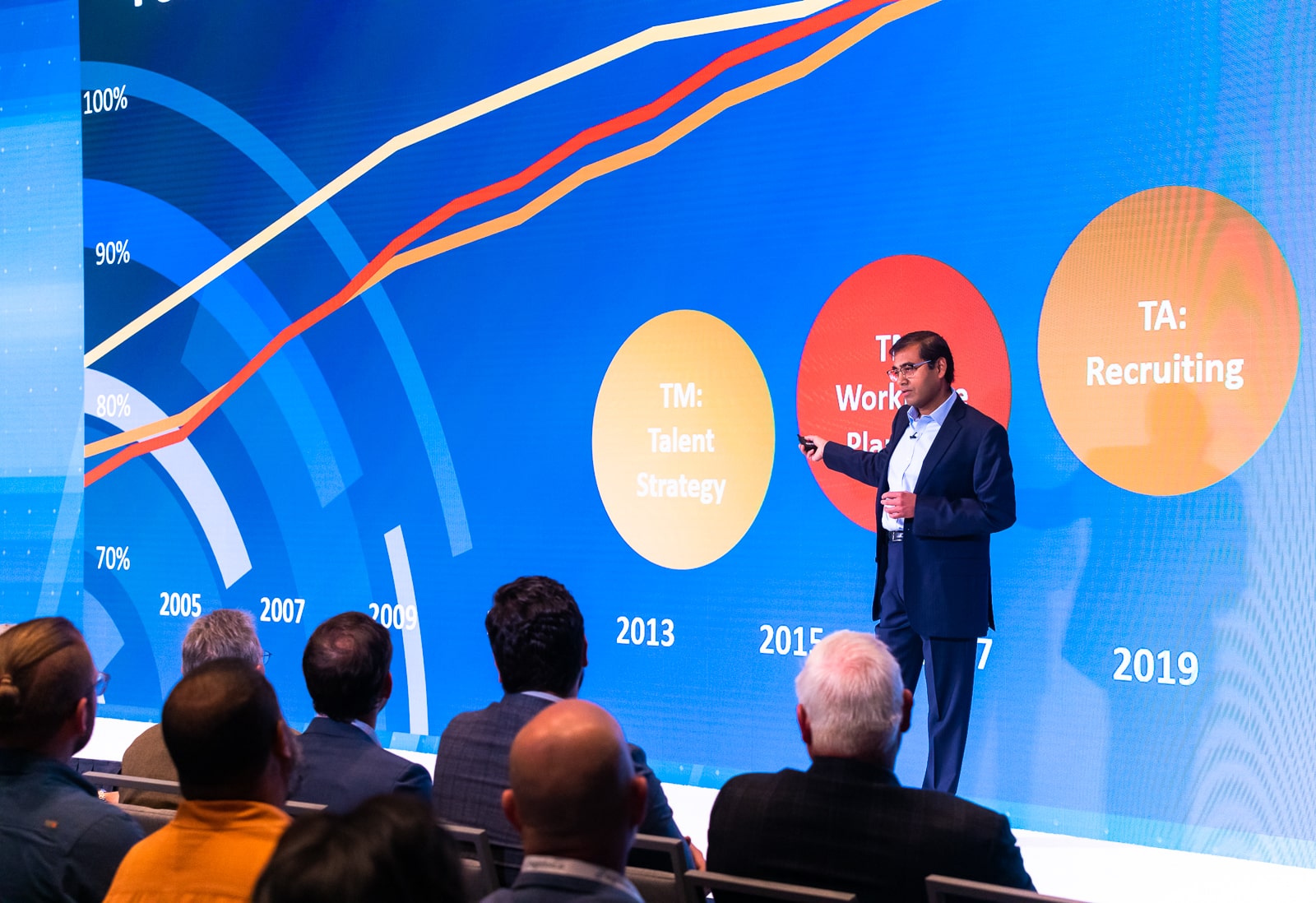
Former Eightfold AI President Kamal Ahluwalia joined Maria Howard, Partner and General Manager for Heidrick Digital, to discuss the need for a paradigm shift in managing talent, specifically using technology to identify potential leaders poised to navigate change.
“[AI-Powered Talent Intelligence] can show us things about talent and leadership that we did not even know we needed to know,” Ahluwalia said. “Who has done well when actually acquiring another company or an asset? Who did well in divestiture? Who did well in launching new products? What did this individual do in that opportunity? All of those are learnings and skill sets that are not often pulled out, but it goes a long way and it changes your thinking on what a great leader looks like.”

RELATED CONTENT: Read how ChatGPT is going to change the future of work with our report.
Find future-ready leaders who can navigate change
Cultivating future leadership requires innovative approaches that are difficult to unearth at the breakneck speed of change organizations now find themselves in. Currently, many new roles are emerging across organizations to handle these new challenges, particularly at the C-level. Roles like chief growth officers, chief risk officer, or chief strategy officer didn’t exist a few years ago, and the skills required to fill these new roles are very different from traditional C-level roles.
Additionally, the constantly shifting landscape also means new experiences and areas of expertise are shaping how leaders drive impact to a business. All of this is creating the need for a data-driven approach to succession management and talent management as a whole.
The ability to define, measure, track, and apply experience and skills at a granular level is becoming more important to identify and keep these new leaders. Understanding what people in the organization are doing in their current roles (behaviors, results, competencies, experiences) that moves the needle on organizational objectives is a key piece in making the right decisions about fostering future leaders.
Being able to answer questions like who are the leaders throughout the organization whose impact aligns to where the business is going? Or who is noticing what’s coming and making the right adjustments that have the most positive impact? Understanding these key differentiators in potential leaders — no matter where they come from — is the new imperative.
RELATED CONTENT: Learn how a skills-based approach makes succession planning easier.
A full assessment and development of future leaders
Not many CHROs can confidently tell you they know who the next leaders are below the top three levels of the organization. Yet, the opportunity to definitively know this is here with technology.
If we think about how more organizations and their leaders are already moving toward developing skills-based organizations, it should stand to reason that aggregating a massive database with individuals and their skills would be a start. But to truly understand what employees are doing in their current roles and what they are capable of in the future goes beyond a simple skills and people inventory.
“It’s also about understanding the adjacency of skills, the learnability of skills, and documenting as much as possible,” Ahluwalia said. “When we understand the context in which those skills were acquired and what an individual has done with those skills that reflect their capabilities, and we get granular on what they are capable of learning and they can demonstrate the future application of that learning, I think sky’s the limit on potential.”
It’s widely known that organizations that invest in their employees tend to get better results. The challenge is understanding what type of learning and development investments make the most impact. What if organizations could be precise about investing in employees at the individual level?
For instance, there might be people who are fantastic employees and show great potential, but they need access to certain experiences or exposure in a few areas to build on that potential. Simply enrolling them in a generic program isn’t going to develop their growth of future contributions. But with technology, the organization can get more focused on developing individuals to their highest potential by creating a more focused, individualized plan that empowers them, and in turn, better serves the entire organization.
Right now, data on any job, its function, and geography exists in most organizations. Effective talent management is about pairing individuals with all the new opportunities that emerge within that organization. But, what if you bring in decades of data on leadership development, succession planning, successes, or bottomline impact? Suddenly, you have a rich source of information on what your future leaders will need to know to carry out organizational objectives.
Ahluwalia said that’s probably the best insight that can be delivered to any organization, but this approach has to be able to scale. And to do that, you need a talent intelligence platform to deliver the insights and proposed learning plans to get there faster.

The transformative ROI of talent intelligence
What changes in an organization when talent intelligence is applied to talent management? In our work with customers, we see organizations gain a much better understanding of their talent, and what skills and behaviors contribute to better overall performance. This kind of insight can be transformative.
Ahluwalia shared the example of DICK’S Sporting Goods. The company conducted an independent study to look at store performance, and the findings showed that the store manager is the biggest factor in how well a store performs over a period of time. Next, they distilled down what store managers were doing at successful locations, which included data on store manager’s skills, behaviors, learnings, and career paths. That data ended up turning into templates for succession planning across the entire organization.
The DICK’S Sporting Goods team was tested within weeks when the pandemic hit. Store managers had to quickly refocus their teams to respond so there was no disruption to the business and enact new safety procedures, efficient website orders, and curbside pickup. The result was stores performed well during the crisis because the right managers were in place.
With the rapid changes that have become the norm in most business environments, organizations are still determining what the next few years will hold and what skills their talent will need to be successful. Technology like Eightfold’s Talent Intelligence Platform reveal how organizations can do a better job with their talent and foster future leaders ready to tackle and overcome the challenges that lie ahead.
For more insights on talent management, watch the full conversation about talent management with Eightfold and Heidrick & Struggles.